Use a playful result without turning it into a label
Five concrete ways to compare entertainment quiz answers with a friend.
Begin with the choice, not the title
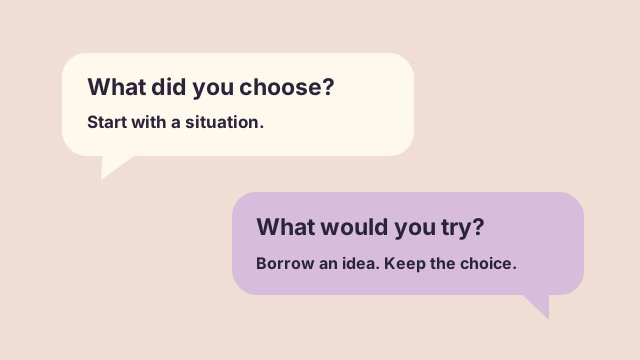
Two people can receive “Story Collector” for different reasons. One chose a maker’s stall because they like practical demonstrations; another chose it because they enjoy conversation. The label compresses those choices and loses some of the detail. Start by asking which question felt most like a real preference.
A useful opening is “I picked the quiet square because I wanted a break.” It gives another person a situation they can understand. “I am a quiet type” makes a broader claim that the quiz has not established.
Make disagreement easy
A result is allowed not to fit. Our descriptions are written for fictional scenarios and selected by a simple vote count. They are not hidden knowledge about the reader. If a friend says the description misses them, treat that as information about the limits of the exercise rather than resistance to a truth.
Try asking which sentence they would change. A specific correction can lead to a better conversation than arguing over whether an entire label is right. No one needs to defend an answer that was chosen quickly or in a different mood.
Compare constraints as well as tastes
The adventure quiz offers a museum, a shaded square, a market, and an unfamiliar lane. In a real outing, opening hours, accessibility, weather, and budget might determine the choice before preference enters the picture. The fictional scenario cannot carry all those constraints.
If you use the result to plan something together, put practical needs back into the discussion. A person selecting a quiet seat may be describing comfort, not a permanent social preference. Ask directly rather than trying to infer the reason from a result name.
Borrow one suggestion from another result
A result page can work like a menu. Someone who prefers a structured plan might borrow the suggestion to leave one hour open. Someone who enjoys wandering might borrow the suggestion to set a return time. Combining concrete ideas avoids the pressure to act consistently with a single identity.
This is why all result descriptions are readable before taking the quiz. They are not secret revelations that require a form, account, or personal details. The interaction is a way to organize suggestions, not a gate around them.
Keep private things private
You do not need to enter a name, birthday, relationship history, or contact information to use our quizzes. The selection logic runs in the page and does not send answers to Akkopo. A shared link opens the quiz, not a stored profile of your attempt.
A friend can also choose not to compare results. A small entertainment activity works best when passing is easy. If a conversation reaches a serious question about health, relationships, work, or safety, a fictional style label is not evidence for a decision. Ask the real question using the information and support appropriate to it.
These scenarios and worked examples were written for Akkopo. Reasoning is shown on this page; fictional situations are not presented as observed data.