Can you run a tiny tournament?
Pair the players, count the matches, and check what a scoreboard really says.
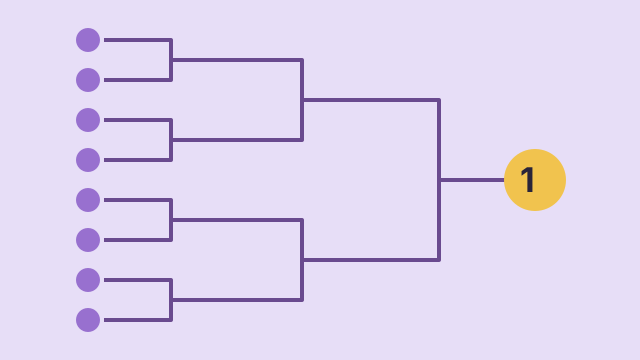
Eight friends want to play, but the whiteboard has become more confusing than the game. These puzzles compare two simple tournament formats and a small scoring table. All rules are supplied, including whether draws can happen.
The names and results are invented. This is a scheduling and counting challenge, not sports prediction. You can sketch brackets, list pairs, or count each match directly; there is no preferred method as long as it respects the stated format.
Give it a go
0 of 5 answered
Answers, with the working
Open an explanation whenever you like. Looking at the reasoning is part of learning, not a rule violation.
01 Four players each play every other player once. How many matches are there?
Answer: 6
Label the players A, B, C, and D. The pairs are AB, AC, AD, BC, BD, and CD: six. Multiplying four players by three opponents counts each match twice, once from each player’s viewpoint. Dividing that twelve by two gives the same result as listing the pairs.
02 Eight players enter single elimination with no byes or draws. How many matches determine one champion?
Answer: 7
Each match eliminates exactly one player. To leave one champion from eight entrants, seven players must be eliminated, requiring seven matches. You can also count four quarterfinals, two semifinals, and one final. The elimination argument works without needing to draw the whole bracket.
03 A win earns 3 points and a draw 1. A player has 2 wins, 1 draw, and 1 loss. How many points?
Answer: 7
Two wins earn six points and the draw adds one, totaling seven. The loss adds zero under the stated scoring system. Counting matches rather than points would answer a different question: the player has played four matches, but points need not equal the number of matches.
04 Three matches each last 20 minutes. One court runs them consecutively, with a 5-minute gap between matches only. How long from first start to last finish?
Answer: 70 minutes
The play takes sixty minutes. Three consecutive matches have two gaps between them, adding ten minutes. There is no gap before the first or after the last because the question excludes those. Counting gaps is another place where the number of spaces differs from the number of objects.
05 Four players each play all others once. Could all four finish with 3 wins, if there are no draws?
Answer: No
There are six matches, each producing one win, so the entire tournament contains six wins. Four players with three wins each would require twelve wins. The proposed table violates the total before you even inspect individual pairings. Checking a conserved total is a fast way to catch an impossible scoreboard.
Two ways to catch a counting error
List a small case before reaching for a formula. Four players produce only six pairs, so it is practical to write them all out. Then look for double counting: AB and BA describe the same match in a single round-robin tournament.
In an elimination event, count the thing that disappears. Every match removes one player from contention. That makes the number of eliminations an especially stable check, even when the bracket layout looks complicated. The assumptions matter: a replay after a draw would add a match without eliminating anyone.
A scoreboard audit you can reuse
For a no-draw tournament, total wins must equal total losses and must equal the number of completed matches. Build your own four-player results table, then check all three totals. This is an original exercise with invented data, not a claim about a real competition or a ranking of visitor performance.
These scenarios and worked examples were written for Akkopo. Reasoning is shown on this page; fictional situations are not presented as observed data.
Something unclear? Suggest a correction.