Fictional power workshop
Build a character power with a cost and a limitation. Export a story brief that gives the character a problem to solve.
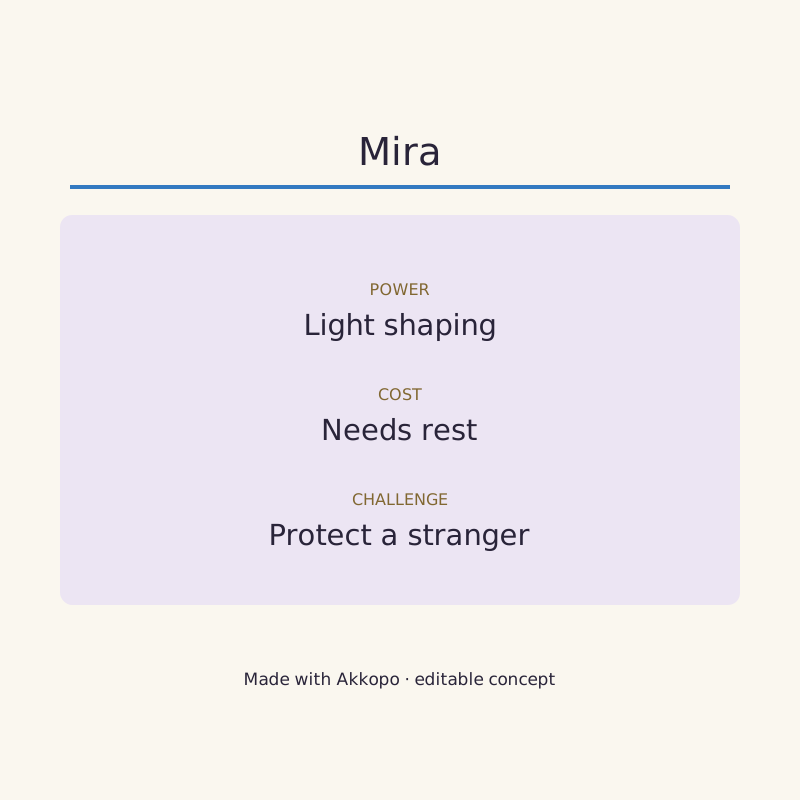
Fictional power workshop
Build a character power with a cost and a limitation. Export a story brief that gives the character a problem to solve.
Try a second version
A limitation makes a power usable in a story. Write a scene where the character must win without relying on the strongest ability.
All changes and downloads happen in your browser. Nothing you type is sent to us. SVG downloads can be edited in a vector editor; the text download keeps your choices and notes.
The original word-to-result game
The archived game below selects a preset fictional result. It is separate from the design tool above and cannot measure rarity, predict a future or reveal another person’s feelings.
About the archived wording: percentage, rarity, IQ, timed-performance and mind-reading claims in the original copy below are fictional challenge language, not measured findings. The rules and result labels are preserved for entertainment.
Deep inside every name sits a power that never got its origin episode. Yours has been dozing under the surface, waiting for the right moment and a slightly dramatic gust of wind. We read the letters, find the shape of the ability curled up there, and give it a proper name.
What follows is your awakening scene, plus the power your name has been guarding all along. Read it the way the music would swell. Picture the exact instant it activates and who happens to be watching. Then send the reveal to whoever would immediately demand a rematch.
Read every possible result and what it means →
The awakening scene has a business behind it
The moment where an ordinary character discovers a sleeping ability is not simply a matter of taste. It is a structure that a magazine economy rewarded for decades. Weekly Shonen Jump has been published by Shueisha since 1968, and for most of that run it has been steered by reader questionnaires: postcards at first, later online forms, asking readers to rank the serials in each issue. Those rankings influence where a chapter is printed and, in time, whether a series survives at all.
A writer working under that pressure learns to close every instalment on a rise. An unexplained power surfacing at the worst possible moment is an efficient way to manage it, because it settles the fight in front of the reader while opening a larger question. The magazine's long-quoted trio of themes, usually given in English as friendship, effort and victory, is generally said to have come out of the same reader surveys.
Power systems are written to be argued with
Long-running action series tend to formalise their abilities. Techniques acquire names, tiers, stated costs and awkward restrictions, and the restrictions matter far more than the spectacle. A power with no price cannot lose in an interesting way, so authors build in cooldowns, recoil, conditions and binding vows. What results reads a little like a rulebook lodged inside a story.
That is deliberate, and it feeds the part of fandom that lives outside the page. Henry Jenkins argued in Textual Poachers, published in 1992, that fans are active readers who rework and extend what they consume rather than receiving it quietly. Ability systems hand them the raw material: a shared grammar precise enough to sustain matchup arguments, fan wikis, amateur translations and forum threads that run for years.
What a name carries, and what it does not
Names in the medium often do real narrative work. Japanese naming lets a writer choose written characters whose readings carry meaning, so a name can hint at a role, a lineage or a flaw before anyone explains it. Translators then face a genuine dilemma: keep the sound, gloss the sense in a note, or replace it with something that lands in English. Fan-subtitled releases used to solve this by crowding translation notes along the top of the frame.
None of that means your own name is holding a technique in reserve. This page turns whatever you type into a number and hands back one of five inventions, which is a coin toss with better staging. The reveal is worth exactly as much as the fun of showing it to someone who immediately wants a different one.
Reading context & limits
For background and a fuller source trail, read How a Meme Actually Spreads. These references provide context; they do not validate the entertainment result or every historical detail in the archived essay.
Content lead: LISA. Updated October 25, 2026. Send a specific factual correction.