The café receipt challenge
Split a bill, resize a recipe, and untangle a discount without racing the clock.
The café in this quiz is fictional, but its arithmetic is deliberately ordinary. Prices include everything stated; there are no hidden taxes, currency conversions, or tipping customs to guess. Each problem changes just one part of a familiar calculation.
These are worked number puzzles, not financial advice. Slow down when a percentage appears. Ask which amount it applies to and whether the quantity you are comparing has also changed. You can use a calculator, and your result will be scored exactly the same way.
Give it a go
0 of 5 answered
Answers, with the working
Open an explanation whenever you like. Looking at the reasoning is part of learning, not a rule violation.
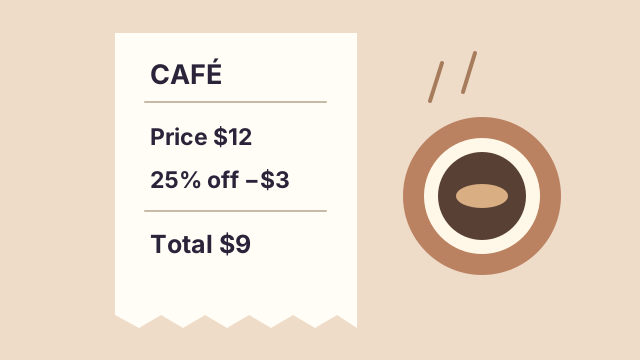
01 A $12 lunch is reduced by 25%. What is the new price?
Answer: $9
A quarter of $12 is $3. The discount removes that $3, leaving $9 to pay. The most tempting wrong answer is the amount saved rather than the new price. Read the final words of a question before choosing: a correct intermediate calculation can still answer a different question.
02 A recipe for 4 people uses 300 g of rice. At the same serving size, how much is needed for 6 people?
Answer: 450 g
Six servings are one and a half times four servings. Multiply 300 g by 1.5 to get 450 g. Alternatively, divide by four to get 75 g per person, then multiply by six. Both approaches preserve the same serving size, which is the relationship the question asks you to hold constant.
03 Three friends split a $42 bill equally. One friend has already paid a $6 deposit toward their own share. How much more does that friend owe?
Answer: $8
Each full share is $42 divided by 3, or $14. The deposit belongs to one friend, so subtract $6 from that person’s $14 share to get $8 remaining. The other two still owe $14 each. The remaining payments total $36, and adding the deposit restores the original $42.
04 A drink rises from $5 to $6, then falls by 20% of its new price. Where does it end?
Answer: $4.80
Twenty percent of the new $6 price is $1.20, so the final price is $4.80. The rise was also 20%, but it was calculated from $5. Equal percentage increases and decreases do not cancel when their starting amounts differ. Tracking the dollar change at each stage makes that visible.
05 Bag A contains 250 g of coffee for $5. Bag B contains 400 g for $7. Which costs less per 100 g?
Answer: B at $1.75
Bag A costs $5 divided by 2.5, which is $2 per 100 g. Bag B costs $7 divided by 4, or $1.75 per 100 g. The larger sticker price buys more coffee, so sticker prices alone are not comparable. This puzzle assumes the coffee is otherwise equivalent; real purchasing choices can involve other considerations.
Keep a units column
For a longer problem, write the units beside every number: dollars per person, grams per serving, or dollars per 100 grams. These labels are a compact error detector. If your calculation ends with grams when you are asked for a price, you have probably stopped at the wrong stage.
The deposit problem rewards a simple audit. Add the money already paid to the money still due. If that sum differs from the bill, the proposed split cannot work. A second method is often more useful than repeating the same arithmetic twice.
Change one assumption
Try rewriting the recipe puzzle for five people instead of six. The per-person method still works, while a remembered answer does not. This is an easy way to turn a finished quiz into practice that actually changes what you can do. The challenge is to preserve the relationship, not the particular numbers.
These scenarios and worked examples were written for Akkopo. Reasoning is shown on this page; fictional situations are not presented as observed data.
Something unclear? Suggest a correction.